Service Dog Tasks and the Public Access Test, Explained
This page explains the law in general terms. It is not legal advice. For a specific situation, contact the agency listed on this site or an attorney.
Two questions come up again and again for Tennessee handlers and owner-trainers. What tasks can a service dog do, and does a dog have to pass a public access test? This guide answers both in plain English and walks you through building tasks and preparing for the test step by step.
The short version is this. Under the Americans with Disabilities Act (ADA), a dog is a service animal because of what it is trained to do, not because of a test, a card or a certificate. The public access test is a respected training benchmark. It is not a legal requirement under the ADA.
What counts as a service dog task
ADA.gov's Service Animals FAQs define a service animal as a dog that has been individually trained to do work or perform tasks for an individual with a disability. Two ideas matter here: the training is individual, and the work is tied to the person's disability.
A task is a specific, trained action that helps with a limitation caused by the disability. It is something you could teach, cue or reinforce, and describe in a sentence. "Retrieves dropped items for a person with limited reach" is a task. "Makes me feel better" is not.
Why comfort alone is not a task
Emotional support, therapy and comfort animals are not service animals under the ADA. A dog's calming presence may matter a great deal to its owner. But the ADA looks for trained work or tasks, and presence alone does not meet that definition.
A psychiatric service dog is different. A dog trained to interrupt a panic episode, wake a person from a nightmare or create space in a crowd is performing trained tasks tied to a disability.
What tasks can a service dog do? Examples by disability
These are common examples of service dog tasks. They are illustrations, not a complete or official list, and the right tasks depend on the individual handler. For how the ADA treats these questions, see the ADA.gov Service Animals FAQs.
| Type of disability | Examples of trained tasks |
|---|---|
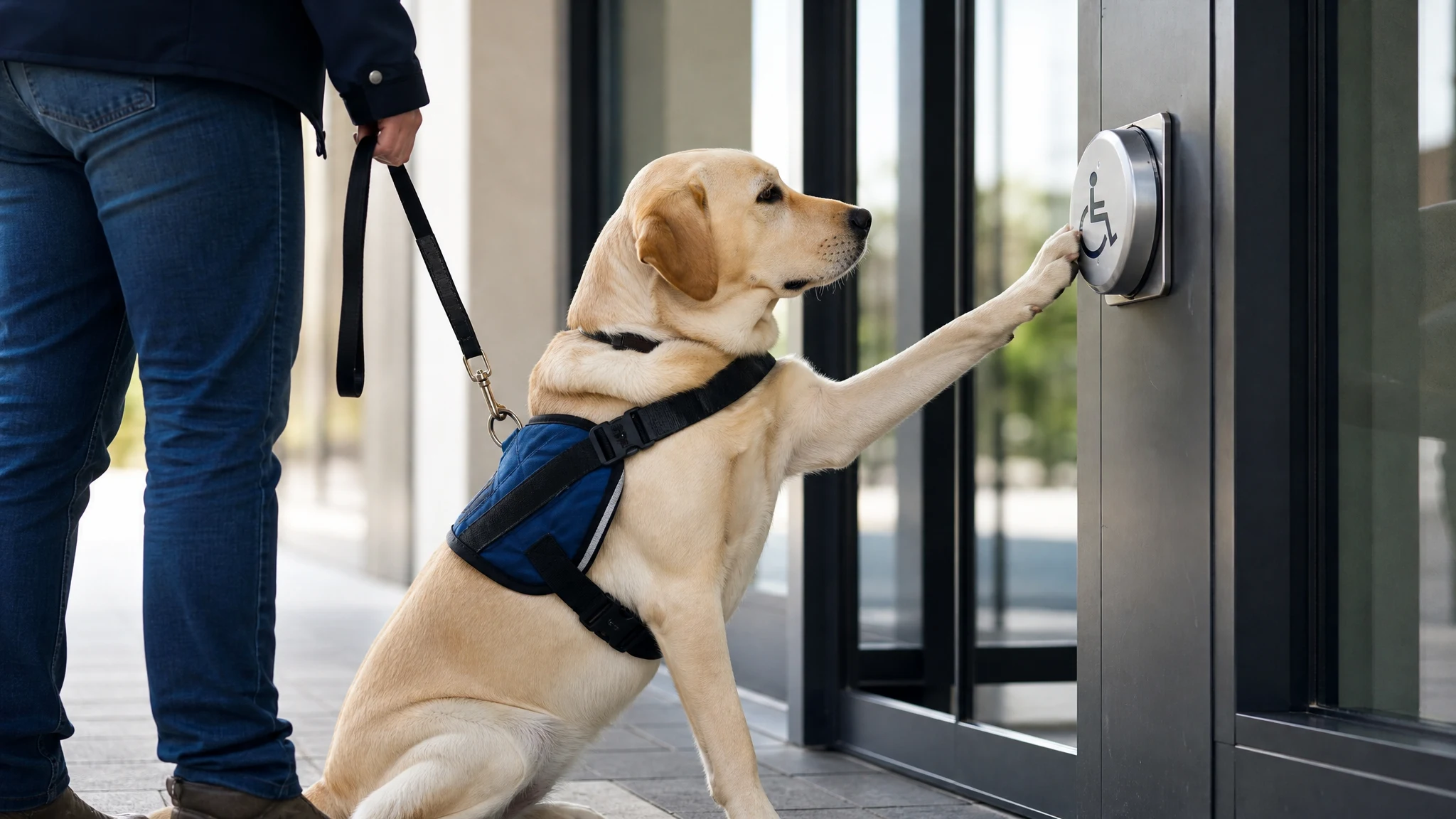
| Mobility | Retrieving dropped items, opening doors, turning on lights, providing bracing or balance support, pulling a manual wheelchair |
| Vision loss | Guiding around obstacles, stopping at curbs and stairs |
| Deaf or hard of hearing | Alerting to a doorbell, alarm, name being called or approaching sound |
| Seizure disorders | Staying with the person, summoning help, retrieving a phone or medication |
| Diabetes and other medical conditions | Alerting to a change the dog has been trained to indicate, fetching supplies |
| PTSD and other psychiatric disabilities | Interrupting repetitive behaviors, waking a person from nightmares, turning on lights, blocking or creating space in crowds |
| Autism | Interrupting self-harming behavior, preventing a child from bolting, as trained for that individual |
Notice the pattern. Each task is a trained response to a specific need. If you cannot name the task and the disability-related reason for it, the dog is probably not yet a service dog under the ADA definition.
The two questions staff may ask
ADA.gov says that when it is not obvious what a dog does, staff may ask only two questions:
- Is the dog a service animal required because of a disability?
- What work or task has the dog been trained to perform?
Being able to answer the second question in one clear sentence is the practical reason to define your dog's tasks. Staff may not ask for paperwork or a demonstration. This is also why no registry paperwork carries legal weight. There is no official service dog registry or required certification under the ADA, so online registrations, ID cards and certificates are not legal proof of anything.
What the public access test is, and what it is not
The public access test is a training benchmark associated with Assistance Dogs International (ADI). It checks whether a dog can behave reliably and stay under control in public places, such as while walking through crowds, passing food and other dogs, riding in vehicles or settling during a meal.
It is not an ADA requirement. The ADA does not require any test, and a dog that has not taken one does not lose its protections if it is individually trained and under control. A dog that passes a test is not automatically a service animal either. The tasks still have to exist.
So why use it? Because it gives you a clear, structured way to judge whether your dog is ready for public life. The exact items and scoring come from the organization that runs the test, so check with ADI or an accredited program for the current version before you rely on any list, including ours.
How to train tasks and prepare for a public access test
Materials you will need
- A flat buckle collar or a well-fitted harness, plus a standard leash
- Small, soft treats your dog loves, and a treat pouch
- A clicker or a consistent marker word such as "yes"
- A mat or a portable bed for settling practice
- Task props, such as a tug strap for door opening or items to retrieve
- A notebook or phone app to log training sessions and progress
- A helper or two for distraction practice
All methods below are reward-based, in line with the position of the American Veterinary Society of Animal Behavior (AVSAB). Do not use shock, prong or choke collars, alpha rolls, scruffing or dominance methods. They add fear and stress, and they work against the calm, confident behavior a service dog needs.
Step 1: Write down your needs and the tasks
List the specific limitations your disability causes. Next to each, write a task that could help. Keep each task to one clear action, for example "picks up dropped keys and places them in my hand."
This list is your training plan. It also gives you your answer to the second ADA question.
Step 2: Check that the dog is a good candidate
Not every dog suits public work. Look for steady nerves, a willingness to work and good health. A dog that is fearful, reactive or easily overwhelmed may be happier and safer as a pet. Be honest here. It protects the dog and you.
If you would rather work with a program than train your own dog, Tennessee has several. Retrieving Independence in Nashville and Smoky Mountain Service Dogs in Lenoir City are both ADI accredited. Working Dogs For Vets in Lawrenceburg and Warrior Freedom Service Dogs in Chattanooga serve veterans. Contact each directly for current costs, eligibility and wait times.
Step 3: Build the foundation at home
Teach reliable basics in a quiet room first: sit, down, stay, come, loose-leash walking, settling on a mat and a calm "leave it." Mark and reward the behavior you want, then gradually ask for longer durations and more distance.
Keep sessions short, usually a few minutes, and end on a success.
Step 4: Teach each task in small pieces
Break each task into steps. To teach a retrieve, for example, first reward the dog for looking at the item, then for touching it, then for picking it up, then for holding it, then for bringing it to you and finally for placing it in your hand.
Add a cue only after the dog offers the behavior reliably. Then practice the task in different rooms, with different items and at different times of day.
Step 5: Add distractions and new places gradually
Move from your living room to the yard, then a quiet street, then an open-air spot, then a pet-friendly store and so on. Only go where dogs are allowed during training, and follow each venue's rules. Use short visits, and keep your distance from distractions at first.
If your dog cannot take a treat or respond to a cue, you have moved too fast. Go back one step.
Step 6: Practice the public access skills
Work on the kinds of behavior a public access test looks at:
- Walking beside you on a loose leash through crowds and doorways
- Ignoring dropped food, people who try to pet or call the dog, and other animals
- Settling quietly under a table or beside a chair for an extended time
- Staying calm around carts, strollers, elevators, sudden noises and slippery floors
- Entering and leaving vehicles calmly
- Staying in position when you move away, then returning on cue
- Keeping toileting under control, using a cue in an appropriate place
Ask a helper to play the role of a distraction. This lets you rehearse real situations before they happen.
Step 7: Run a mock test, then a real one if you choose
Get the current test items from ADI or an accredited training program, then run a practice session with a friend who can score honestly. Write down what went well and what did not. Retrain the weak spots and repeat.
If you want a formal evaluation, ask an accredited organization whether it offers one and what it costs. Because the test is a benchmark, how you use the result is up to you.
Tips and common mistakes
- Treating comfort as a task. A dog that simply stays close is not performing trained work. Define and train a specific action.
- Skipping individual training. The ADA definition says individually trained. A dog's breed or temperament alone does not qualify it.
- Buying a registration, vest or certificate and calling it done. These do not create legal status. A vest may help signal that the dog is working, but it is not required by the ADA and does not replace training.
- Rushing into public. Work up in small steps. One bad experience can set training back.
- Using too few rewards in new places. Pay generously when the challenge is higher.
- Training when the dog is tired or overstimulated. Watch for yawning, sniffing, avoidance and stress, and end the session.
- Forgetting maintenance. Keep practicing tasks and public manners throughout the dog's working life.
What Tennessee law adds
Tennessee's public access statute, Tenn. Code Ann. 62-7-112, uses the term "dog guide" rather than "service animal." According to the Animal Legal and Historical Center's summary of Tennessee's assistance animal laws, it covers a blind, physically disabled, or deaf or hard-of-hearing person led or accompanied by a dog guide. Places of public accommodation may not refuse a covered person with a dog guide, and they may not require documentation about the dog. A venue may ask that a dog that is out of control or not housebroken be removed. A violation is a Class C misdemeanor.
The ADA covers a broader range of disabilities than that Tennessee statute, so the federal definition above is the one to rely on for most public access questions. Tennessee's statute has also been amended over the years, so check the current text with the state.
For dogs in training, the same source says Tennessee's rules work through trainers. A dog guide in training means a dog being trained by an employee or puppy raiser from a recognized training agency or school. The trainer must have the dog in a harness or on a leash and present credentials issued by an accredited school for training dog guides. If you are an owner-trainer, check with the state about how this applies to you before you assume access to a place that does not allow pets.
Tennessee also takes false claims seriously. Under Tenn. Code Ann. 39-16-304, misrepresenting a service animal or support animal is a Class B misdemeanor. For misrepresentation of a service animal, the source summary says the court must also impose 100 hours of community service within six months. The conduct covered includes false claims to landlords and false claims or documentation given to a public accommodation employee.
For housing, the same source says a tenant with a disability may request an exception to a landlord's animal policy. A landlord may ask for reliable documentation of the disability and the disability-related need if the disability is not readily apparent, but may not obtain confidential medical records. Documentation from a certificate-for-a-fee website does not count as reliable. Tennessee's housing statute defines a service animal as a dog or miniature horse individually trained to work or perform tasks for an individual with a disability.
For a fuller walk-through of rights, training and access in the state, see our guide to service dogs in Tennessee. This article states the law and is not legal advice. For complaints, check with the relevant agency, since a Tennessee complaint office was not confirmed for this guide. ADA.gov is the place to start for federal questions.
What results to expect
Progress varies a lot from dog to dog. Many handlers find that simple tasks take weeks to teach and that reliable public behavior takes many months of steady practice. Some dogs may never be well suited to public work, and that is a normal outcome.
With patient, reward-based training and regular practice, a well-suited dog may become more confident and focused in public. A structured mock test can help you see where more work is needed. No method can promise that a particular dog will master every task or pass any particular test.