Service Dogs for Veterans in Tennessee
This page explains the law in general terms. It is not legal advice. For a specific situation, contact the agency listed on this site or an attorney.
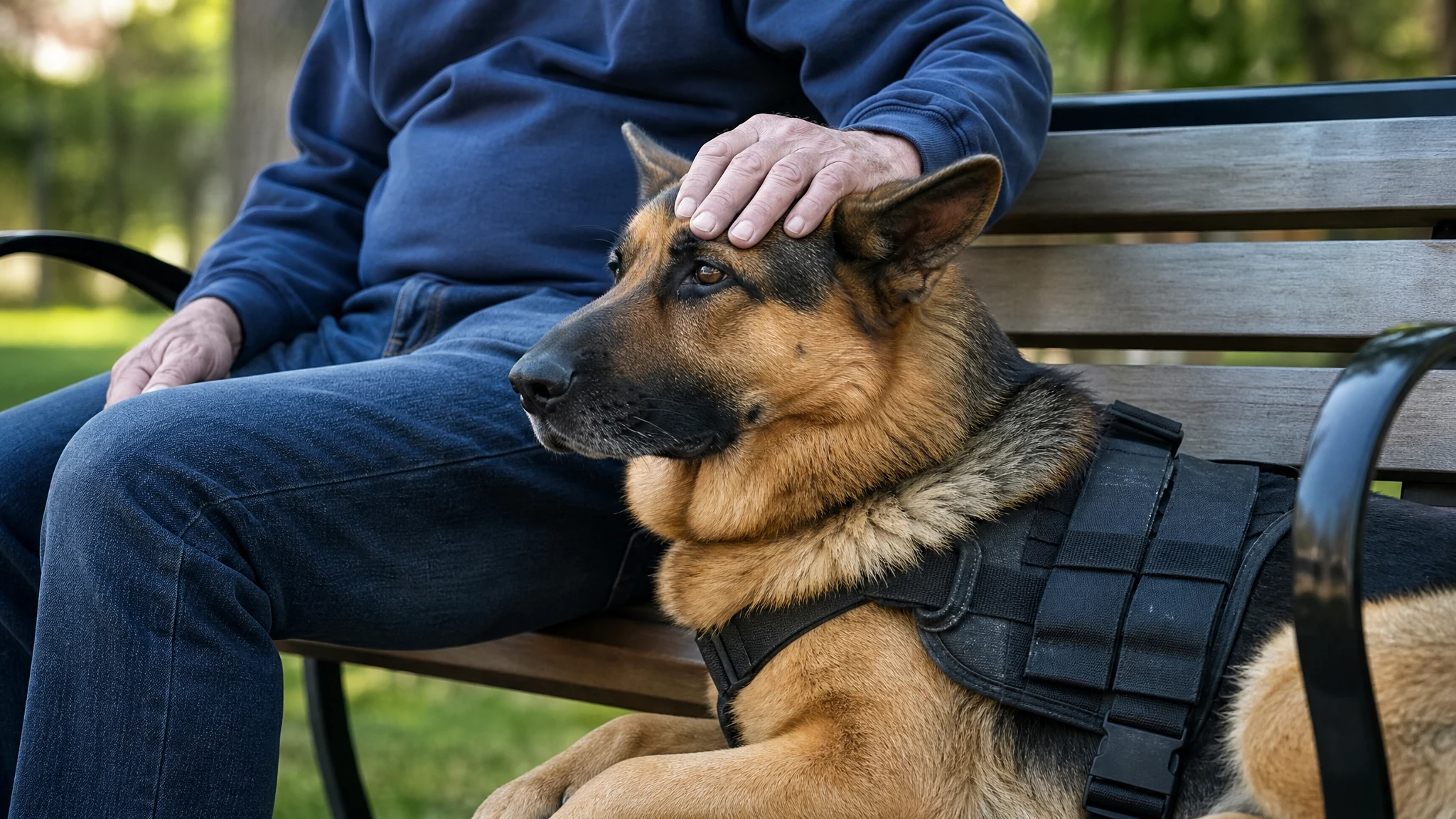
Service dogs for veterans can help with tasks tied to a disability, including post-traumatic stress, traumatic brain injury and mobility limits. In Tennessee, several nonprofits place dogs with veterans, and the Department of Veterans Affairs has a benefit that can help with a dog's care. This guide walks through the process in order, from deciding what you need to submitting an application.
It explains what the law says and where the programs are. It does not promise any outcome, and every program decides for itself who it accepts.
What a PTSD Service Dog Is, and What It Is Not
ADA.gov defines a service animal as a dog that has been individually trained to do work or perform tasks for an individual with a disability. The key words are "trained" and "tasks." For a veteran with PTSD, tasks might include interrupting behaviors, creating space in a crowd, or waking someone from a nightmare. The specific tasks depend on the person and the training program.
An emotional support animal is different. Under the ADA, emotional support, therapy and comfort animals are not service animals. A dog whose only role is to be present and comforting does not meet the ADA definition, even though that comfort may matter a great deal to its owner.
This distinction affects where a dog may go. It also affects how Tennessee law treats claims about a dog, which is covered in the mistakes section below.
What to Gather Before You Start
Here is what to have ready before you contact a program:
- Your discharge paperwork, such as a DD-214, if you have it. Programs set their own proof-of-service rules, so ask each one what it wants.
- A list of the daily situations where a trained dog could help. Be specific, such as crowded stores, sleep, or balance on stairs.
- The name and contact details of the clinicians who treat you. Programs often ask about this, but each sets its own rules.
- Your VA medical center contact information, if you receive VA care.
- Details about your home, such as whether you rent or own, and whether other pets live there.
- A calendar and a notebook for deadlines, calls and answers.
You do not need to buy anything to begin. Be cautious of any site that sells a registration, ID card or certificate. There is no official service dog registry and no required certification under the ADA, so those products are not legal proof of anything.
Step 1: Decide Whether You Need a Service Dog or Support Animal
Start with an honest look at your daily life. Ask what you would want a dog to do, not only how you would want to feel. If you can name specific tasks, a service dog may fit. If you mostly want companionship and calm, an emotional support animal or a pet may be the better path.
Talk this through with your own clinician or VA care team. They know your history, and they can tell you what they are able to document. Neither answer is a failure. It is about matching the right kind of help to your need.
Step 2: Learn the Programs Serving Tennessee Veterans
These organizations are named on their own websites as serving Tennessee veterans. Details below come from each program's site. Wait times were not listed on any of them, so ask each one directly.
Smoky Mountain Service Dogs (Lenoir City)
Smoky Mountain Service Dogs is accredited by Assistance Dogs International (ADI). Its site says it serves veterans and first responders, with mobility assistance dogs and psychiatric (PTSD) dogs when its canine inventory allows. It states that services are provided at no cost to its clients. Visit smokymountainservicedogs.org.
Working Dogs For Vets (Lawrenceburg)
Working Dogs For Vets is a nonprofit that provides service dogs and training for disabled veterans. Its site says it gives priority placement to veterans with combat-related disabilities and lists a 0% cost to veterans. Visit workingdogsforvets.org.
Warrior Freedom Service Dogs (Chattanooga)
Warrior Freedom Service Dogs is ADI accredited. Its site says it places dogs with veterans who have service-induced brain injury such as PTS or TBI, free of charge. Its kennel is at 2401 Bachman St, Suite 4, in Chattanooga, and its mailing address is in Flintstone, Georgia. Visit warriorfreedom.org.
Retrieving Independence (Nashville)
Retrieving Independence, at the Honey Alexander Center in Nashville, is ADI accredited. Its site lists mobility, medical, psychiatric, seizure and military PTSD service dogs. Its cost and waitlist are not stated in the information available here, so ask the program about both. Visit riservicedogs.org.
Step 3: Check What the VA Offers
The VA runs a Service Dog Veterinary Health Benefit. According to the VA, it covers veterinary insurance, equipment and travel for eligible veterans whose dog completed training at an ADI or IGDF accredited organization. You reach it through the Prosthetic and Sensory Aids Service at your local VA medical center.
Note the accreditation condition. Of the programs above, three are listed as ADI accredited: Smoky Mountain Service Dogs, Warrior Freedom Service Dogs and Retrieving Independence. Ask any program you consider whether its training meets the VA's condition. For eligibility questions, such as which conditions qualify, ask the VA directly. Do not assume.
The VA also states that service dogs of all breeds are allowed in VA facilities. You can read its policy at va.gov. For the benefit itself, see the VA prosthetics service and guide dogs page.
Step 4: Contact Programs and Ask the Right Questions
Reach out to more than one program. Policies, service areas and dog supply differ. Questions worth asking:
- Do you accept applications from my branch, era and disability?
- What are the costs, now and later, including travel and equipment?
- What is the current wait, and how do you handle the waiting list?
- What does the training or team-matching process involve, and how long is it?
- Is the program ADI accredited, and does your training qualify for the VA benefit?
- What follow-up or support do you offer after placement?
Write the answers down. Programs describe themselves on their websites, but only the program can tell you where you stand today.
Step 5: Complete the Application
Each program has its own application and its own steps. Expect questions about your service, your disability, your daily routine and your home. Answer plainly and completely. If a form asks for a clinician's statement, give your provider plenty of time.
Some programs also ask for interviews or in-person visits. Treat these as a chance to ask your own questions. A good fit matters for both you and the dog.
Step 6: Prepare for Placement and Daily Life
While you wait, get ready at home. Talk to anyone you live with. Think about your routines and how a dog fits into them. Set up a space for rest, water and a regular schedule.
If you take a dog through training yourself, humane methods matter. The American Veterinary Society of Animal Behavior (AVSAB) supports reward-based training. That means treats, praise and play, and it excludes shock, prong or choke collars, alpha rolls and dominance tactics. A program that works with you should follow the same approach, and you can ask about it.
Your Rights as a Handler in Tennessee
Under the ADA, staff at a business may ask only two questions when it is not obvious what a dog does: whether the dog is a service animal required because of a disability, and what work or task the dog has been trained to perform, according to ADA.gov. They may not ask for documentation as a condition of entry under those rules.
Tennessee has its own statute on public access. Tenn. Code Ann. 62-7-112 uses the term "dog guide" and covers a blind, physically disabled, or deaf or hard-of-hearing person led or accompanied by a dog guide. According to the Animal Legal and Historical Center at Michigan State, places of public accommodation may not refuse a covered person with a dog guide, and may not require documentation about the dog. The dog must be under the handler's control. A venue may ask that a dog that is out of control or not housebroken be removed. The statute has been amended over time, so check current text for details.
The ADA defines disability more broadly than that Tennessee statute, so the federal rules matter for veterans with PTSD. For more on training, access and where dogs may go, see our guide to service dogs in Tennessee.
Housing
Per the Animal Legal and Historical Center summary of Tennessee law, a tenant with a disability may ask for an exception to a landlord's animal or pet policy, including a rule requiring payment for an animal. A landlord may ask for reliable documentation of the disability and the disability-related need if the disability is not readily apparent. A landlord may not obtain confidential medical records. Paperwork from a certificate-for-a-fee website does not count as reliable documentation.
For a complaint or a legal question, check with the relevant agency. A Tennessee complaint agency is not listed in the sources used here, so look to the federal ADA information at ADA.gov. This article states the law and is not legal advice.
Tips and Common Mistakes to Avoid
- Buying a registration or vest package. It is not required, and it is not legal proof. Spend your effort on real training and a real program.
- Claiming a pet is a service dog. Tenn. Code Ann. 39-16-304 makes misrepresentation of a service or support animal a Class B misdemeanor. The Animal Legal and Historical Center summary says that for misrepresentation of a service animal the court must also impose 100 hours of community service within six months. It covers false claims to landlords and false claims or documentation given to a public accommodation employee.
- Applying to only one program. Contact several, since each has its own criteria and supply.
- Assuming free means fast. A no-cost program may still have a long wait. Ask about timing.
- Skipping the VA conversation. Ask about the veterinary benefit early, since it depends on where the dog trained.
- Treating comfort as a task. A dog that comforts is not automatically a service dog under the ADA. The dog needs individual training to do specific work or tasks.
- Expecting a dog to replace care. A service dog is one tool. Keep up with your clinicians and your support network.
One more point on training. Under Tennessee law, access for a dog guide in training is covered through trainers. A dog guide in training means a dog being trained by an employee or puppy raiser from a recognized training agency or school, who must have the dog in a harness or on a leash and present credentials from an accredited school for training dog guides. An owner training a dog alone should check the current law and ask the agencies above how it applies.
What You Can Reasonably Expect
Results differ from person to person. Some veterans report that a trained dog helps them feel more able to leave the house, manage crowds or keep a steadier routine. A dog may also help with certain physical tasks. These are possibilities, not promises, and no program can assure a particular result.
Expect the process to take time, with paperwork, questions and a wait. Expect responsibility too. A service dog needs daily care, exercise, veterinary visits and ongoing practice. Many people find the effort worthwhile, but it is a real commitment.
Where to Start This Week
Pick two programs from the list above and read their application pages. Call your VA medical center's Prosthetic and Sensory Aids Service with your questions. Then write down your top daily tasks. Those three actions will move you from thinking about service dogs for veterans in Tennessee to an actual application.
Sources
- ADA.gov Service Animals FAQs
- Animal Legal and Historical Center, Tennessee Consolidated Assistance Animal/Guide Dog Laws
- VA Prosthetic and Sensory Aids Service: Service and Guide Dogs
- VA: Are service dogs allowed in VA facilities?
- Smoky Mountain Service Dogs
- Working Dogs For Vets
- Warrior Freedom Service Dogs
- Retrieving Independence